Reconstitution of the Review Committee for the Assessment of Contract of Service Personnel
Author: ICTSadmin
-
Special Order No. 2022-013
Reconstitution of the Program on Awards and Incentives Service Excellence (PRAISE) Committee of the Fertilizer and Pesticide Authority (FPA)
-

FPA-CAR partners with government and private agencies in conducting ASD Training
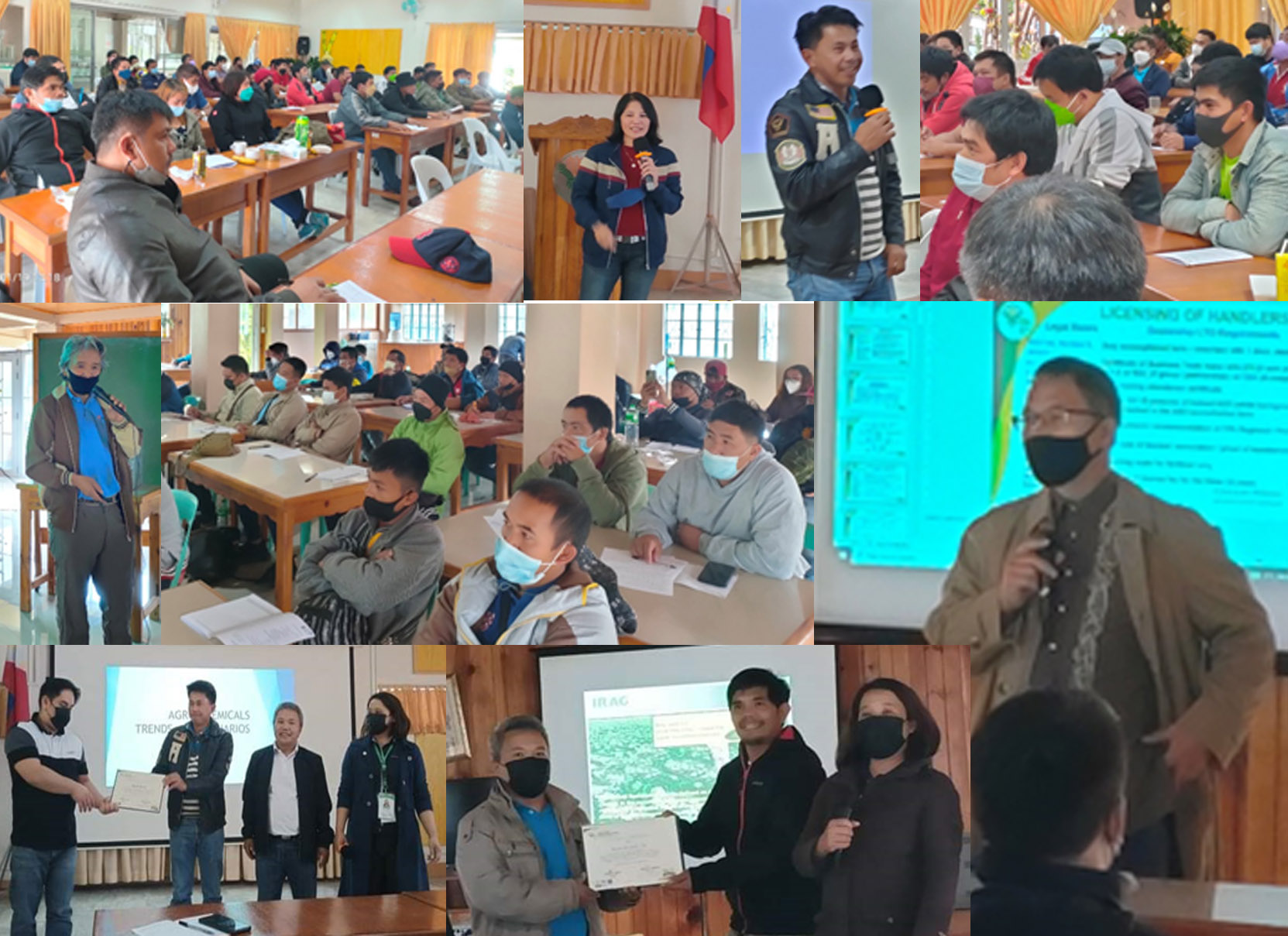
BENGUET, January 21, 2022 – In partnership with the Cordillera Agricultural Research and Extension Organization (CAREO), ATI-CAR, and LGU Buguias, Benguet, FPA-CAR trained eighty-one (81) field personnel of various agrochemical companies on Accredited Safety Dispenser (ASD) of Fertilizers and Pesticides on January 18 to 21, 2022.
The first batch of trainees was conducted on January 18-19 at Aspulan Hall, ATI-CAR, BSU Compound, La Trinidad, Benguet with forty-three (43) participants. Ms. Cristine B. Esnara of ATI-CAR presented the act regarding food safety. While the second batch of thirty-eight (38) participants was briefed on the food safety act by Buguias Municipal Agriculturist Delfin Rufino at JEA’s Building, Loo, Buguias, Benguet on January 20-21.
Other speakers are Mr. Juan Miguel, Jr of Farmfix who discussed fertilizer and pesticide trends and scenarios, and Mr. Jake Bulcio of Syngenta Phils. who shared insights on pesticide mode of actions. In addition, FPA-CAR Regional Officer Rogelio B. Tanguid and Provincial Officer Rowena F. Billig handled the main topics of ASD.
The CAREO officers led by their president Willy Bacagan had organized their members to attend such training in line with their functions as stewards of farm inputs by their respective companies in their areas of assignment within CAR areas. It is in the best interest of the agro-chemical field personnel to educate their client-farmers on the safe and effective use of their respective products.
The CAREO committed to assisting the government entities in performing their duties and functions, especially FPA-CAR, and being advocates of good agricultural practices.
Other members of the CAREO and field personnel of agrochemical companies will be accommodated on the next ASD training to be conducted within the year. ###
Written by: Rowena F. Billig | Published: 24 January 2022
Fertilizer and Pesticide Authority (FPA) Online ISSN: 2815-1674
Published by the FPA Information and Communications Team -

FPA-FRD conducts refresher course for service improvement
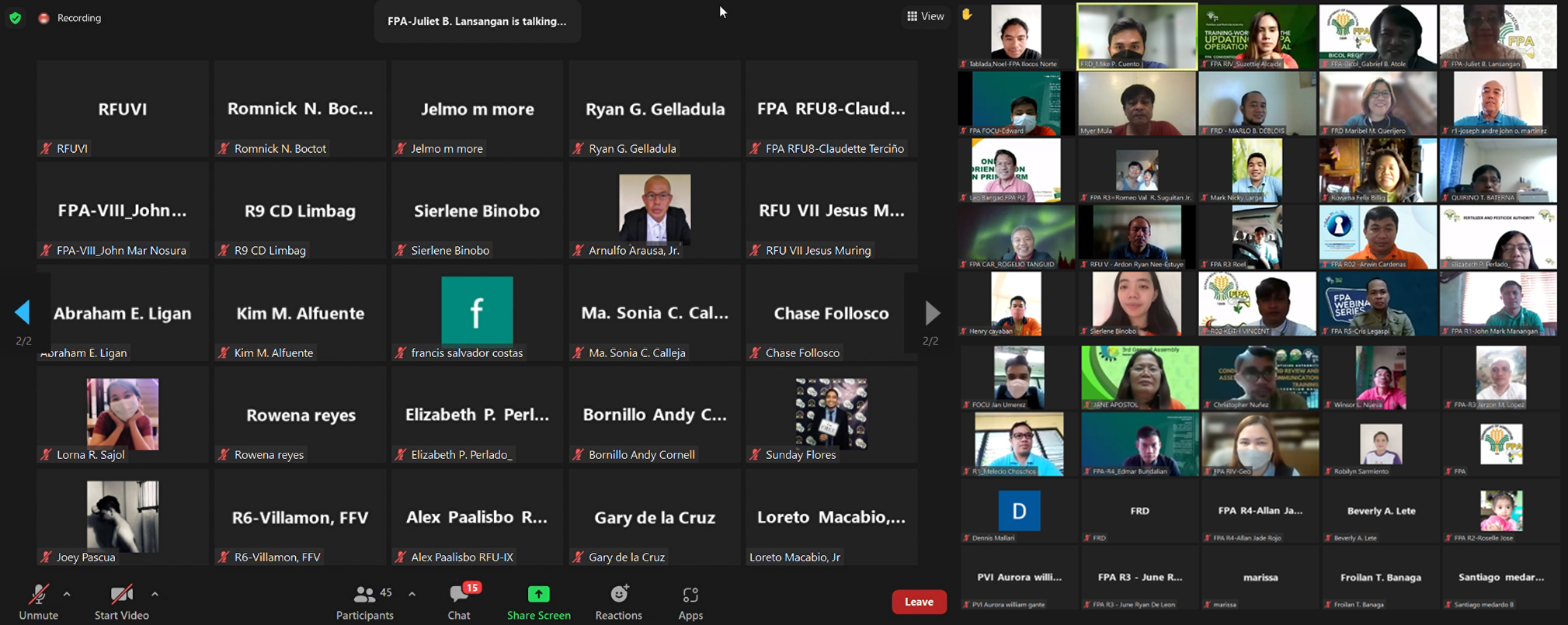
QUEZON CITY, January 20, 2022 – The Fertilizer and Pesticide Authority-Fertilizer Regulations Division (FPA-FRD) central office gathered its regional field units (RFUs) to explore ways on improving regulatory policies and processes through an online refresher course and walk-through of the right processes guided by the mandate of the division.
The assembly was called to harmonize regulatory processes by the FRD reiterating correct implementation of procedures on the Issuance of Certificate of Product Registration (CPR) and License to Operate (LTO) for Fertilizer Handlers, Warehouse Registration, Experimental Use Permit (EUP), and Confirmatory Analysis, and other certificates. These regulatory documents ensure the Agency’s clientele and the agricultural sector of adequate supply at reasonable prices and rationalize the manufacture and marketing of fertilizer.
Discussions of different issues and concerns and the presentation of the approved memorandum for the schedule of audit on RFUs were also part of the agenda. FRD shall perform an audit to ensure that the field units’ delivery of services is compliant with P.D. 1144, its IRR, and ISO 9001:2015 Standards.
The participants also addressed issues on confirmatory analysis which validates and guarantees content claim of fertilizer by the applicants. In the discussion led by Ms. Sierlene Binobo of the FRD, confirmatory analysis is the first requirement for product registration. The evaluation of the laboratory test results is based on the certificate of analysis submitted by the applicant where the product specification is indicated. The conduct of laboratory analysis is performed by either the FPA-Laboratory Services Division or any of the FPA-Recognized Laboratories.
Dr. Mula pointed out the increasing demand for confirmatory analysis accommodated by only five FPA-Recognized Laboratories resulting in delays on the test results release. In response, the FPA will encourage more laboratories capable of fertilizer analysis to undergo the FPA laboratory recognition process and partner up in conducting needed tests.
The FRD was urged to standardize the monitoring form for the evaluation of bioefficacy trial to be used upon the approval of Experimental Use Permit. This will improve RFU’s checking routine during the conduct of bioefficacy trial which will be endorsed to the FPA-FRD as part of the requirement for product registration.
Further, considering to allow licensed institutional users to hire accredited researchers that are affiliated to them in conducting their bioefficacy trials is noteworthy because the institutional use of the product countering the risk of bias posed is prohibited in the current practice. Another major concern raised was the need for an official guideline on the certification of wastewater reuse for fertilization which will be provided by the FRD.
Dr. Mula called to improve the existing application forms for all the processes surrounding the fertilizer regulations as an initial step to enhance the effectiveness of the FPA guided with regulatory policies, he added.
On market monitoring concerns, a formulation of guideline on price tagging of fertilizers at the dealer’s stores was also raised. To ensure transparency with the consumers, the FPA – Field Operations Coordinating Unit (FOCU) will prepare the guideline in coordination with Atty. Pabalate. It will also reinforce monitoring of price and supply activities to protect the public from over-pricing amid the global price increases.
The division, while by the nature of its function is conducting a weekly price and supply monitoring, is now coordinating with the Department of Agriculture (DA) Bantay Presyo Program as part of the One-DA Approach and call to protect the welfare of the consumers. Further, the FRD and FPA-RFUs will conduct public information campaigns using the official FPA and respective RFUs’ social media accounts and intensify the agency’s program to prevent the public from patronizing unregistered fertilizer products circulating in the market.
Observing current restrictions due to the pandemic, the meeting took place via Zoom in January 11-12, officiated by the FPA central office, and participated by Deputy Executive Director for Fertilizer Dr. Myer G. Mula, Atty. Janel Pabalate, Legal Counsel, FRD Chief Ms. Julieta B. Lansangan, Ms. Maribel M. Querijero, Mr. Marlo Deblois, Mr. Jesson E. Garcia, Ms. Jane Apostol, Ms. Sierlene Binobo, and Mr. Mike P. Cuento and Mr. Mark Kevin Salita. The RFUs were represented by the respective regional and provincial officers per region. ###
Sources:
Julieta B. Lansangan, Chief, Fertilizer Regulations Division (FRD)
FPA-FRD and RFU Meeting, January 11-12, 2022
Written by: FPA Info Section | Published: 21 January 2022
Fertilizer and Pesticide Authority (FPA) Online ISSN: 2815-1674
Published by the FPA Information and Communications Team -

Special Order No. 2022-012
Authority to Attend Virtual Planning Workshop for FY 2023 Budget and Plan Proposal
-

Special Order No. 2022-011
Revocation of Special Order No. 115. Series of 2019, “Designation as Special Assistant for Special Concerns in Concurrent Capacity of Planning Officer IV”
-
FPA-FATA commitment remains steadfast conquering new normal set-up
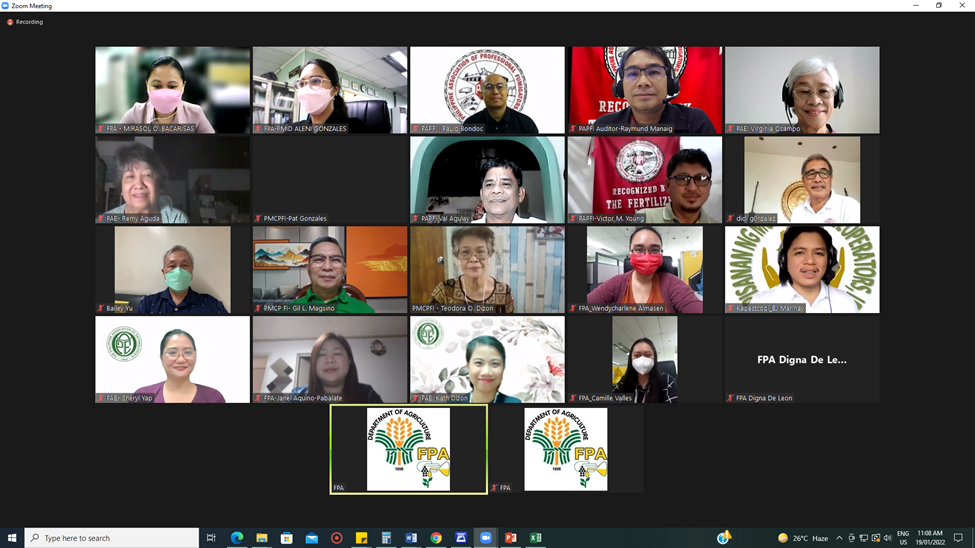
QUEZON CITY, January 19, 2022 – The Fertilizer and Pesticide Authority (FPA) and FPA Accredited Training Association (FATA) conducted an evaluation on the educational and training programs seeking to recognize professionals in the fertilizer and pesticide fields.
FPA and FATA remain in unison in their commitment to providing sound and relevant agricultural training programs, as exhibited in the virtual assembly and singing of a memorandum of understanding (MOU) on January 19, 2022.
FATA is FPA’s partner in educating the agricultural sector in the use of fertilizer, pesticides, and other agricultural chemicals. They create manuals and modules, provide materials, manage the conduct of training and symposium, evaluate participants’ performance, and coordinate with the FPA on complementary training opportunities and initiatives.
The meeting was graced by FATA members: Pest Management Council of the Philippines Foundations, Inc (PMPCPFI), Philippine Association of Certified Pesticide Applicators (PACPA), Philippine Association of Entomologists, Inc. (PAE), Philippine Association of Professional Fumigators, Inc (PAPFI), and the Kapisanan ng mga Pest Control Operators sa Pilipinas (KAPESTCOPI). These organizations composed of professionals in the field of fertilizer and pesticide industry gathered to advance educational programs for practitioners to secure quality and judicious circulation and use of fertilizers and pesticides in the country.
In 2021, FATA conducted 20 training sessions benefitting 670 individuals seeking certification as recognized practitioners in the field. However, 80.45% or 539 examinees took the exams for certification of pesticide applicator certification, and accreditation of care officers (Table 1). Results revealed that individuals who took the tests, 433 (80.33%) passed and were provided with licenses as Agri Certified Pesticide Applicators (CPA) – Fumigators, Agri CPA-Exterminators, Accredited Responsible Care Officers (ARCO), and Fertilizer and Pesticide (F/P) Researchers.
Table 1. Training conducted and exam participants count by the FATA
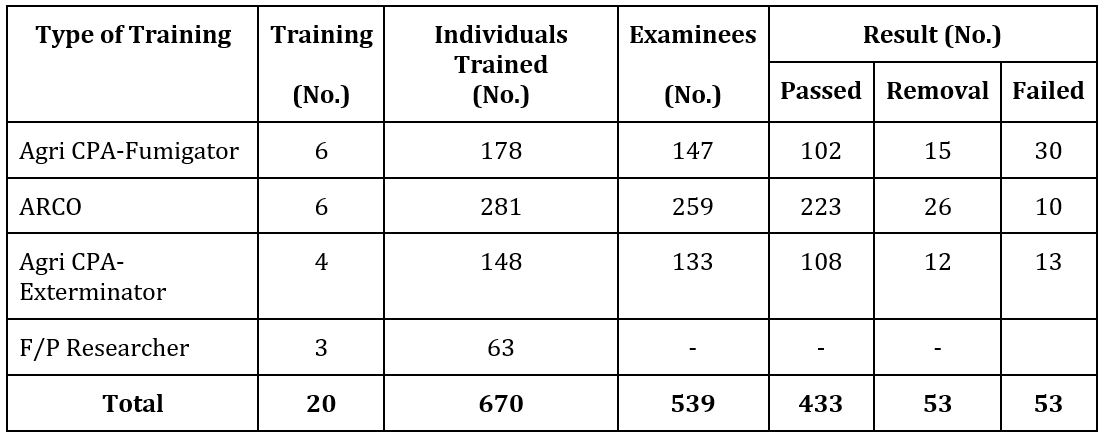
While the passing rate of professionals is high, those that are considered for removal can retake the exam within a year after the release of the result. Examination dates can vary depending on the current health restrictions and the schedule FPA-RFUs, who conduct the said activity,
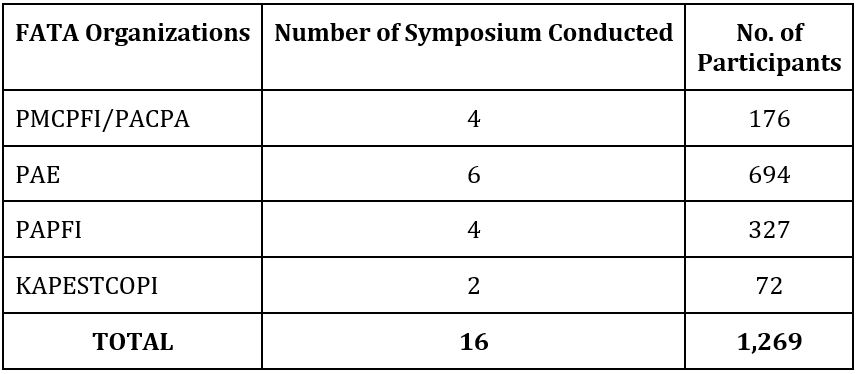
Despite the limitations on mobility and improvised learning setup, FATA spearheaded 16 symposiums on new regulations set by FPA and pest control and management (Table 2). These initiatives are aimed at discussing the pest management situation in the Philippines and the programs created by the FPA and the Department of Agriculture concerning the usage of agricultural chemicals which benefitted 1,269 researchers, care officers, and applicators.
Table 2. Symposiums and participant count of FATA
What to expect in 2022
Practitioners can expect continued training from the FATA on Agricultural CPA-Fumigation and Extermination, ARCO, and F/P Research scattered throughout the year. Schedule of training may be accessed on the FPA website. ###
Sources:
Fertilizer and Pesticide Authority. Memorandum Circular No. 3: Guidelines in the Accreditation of Training Association. July 16, 2019.
FATA and FPA Annual Meeting on January 19, 2021
Written by: Wendycharlene B. Almasen | Published: 20 January 2022Fertilizer and Pesticide Authority (FPA) Online ISSN: 2815-1674
Published by the FPA Information and Communications Team -

FPA, ATI, BSWM lay down initiatives for BFS implementation
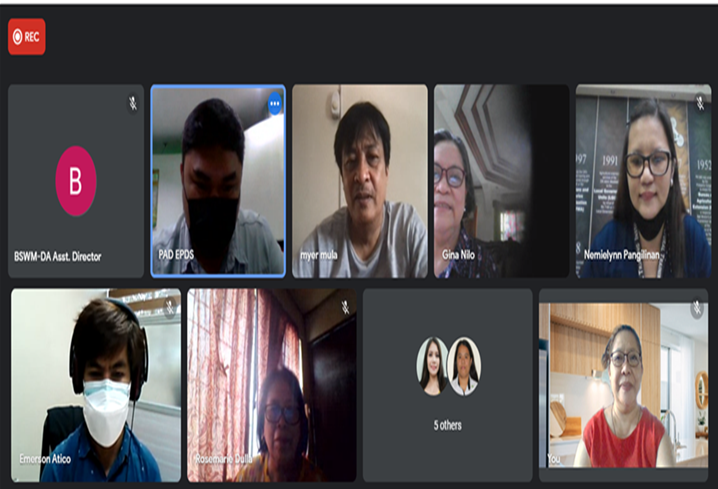
QUEZON CITY, January 18, 2022 – The Fertilizer and Pesticide Authority (FPA), Agricultural Training Institute (ATI), and the Bureau of Soil and Water Management (BSWM) convened to discuss inter-agency initiatives on the implementation of the Balanced Fertilization Strategy (BFS) Program.
To address problems on land degradation and decline in soil fertility, and to aid in the fertilizer price increase through adjustments in the cropping and management systems in farming, the Department of Agriculture (DA) agencies, in tandem with State Universities and Colleges (SUCs) will implement the BFS Program.
The BFS pushes for the use of combined organic and inorganic inputs and other forms of strategy (i.e. cover cropping, individual farmer soil fertility map, improve cropping system etc.) to attain the maximum potential of farmlands while maintaining soil fertility and promoting balanced fertilization. According to Deputy Executive Director for Fertilizer, Dr. Myer G. Mula, the strategy is also a climate-smart adaptation taking into consideration the concept of 4 Rs: Right Nutrient, Right Quantity, Right Method, and Right Time. The concept of balanced fertilization is the key to enhancing the efficient use of nutrients for soil and crop productivity by maintaining soil health and fertility.
Each agency presented their action plans on the implementation of the BFS, with ATI on the Integrated Nutrient Management presented by Ms. Nemielynn Pangilinan, BSWM’s Adaptive Balanced Fertilization Management Program for Sustainable Rice Production discussed by Assistant Director Gina Nilo, and FPA’s initiatives and BFS meeting related updates presented by Ms. Maribel Querijero. Likewise, possible collaborations between said agencies are anticipated.
The primary Balanced Fertilization Strategy – Technical Working Committee (BFS-TWC) will be formed and composed by DA concerned agencies and SUCs with expertise in agriculture as members and collaborators for the successful implementation of the program.
The BFS-TWC will be spearheaded by the Bureau of Soils and Water Management (BSWM) as Chair and the Bureau of Agricultural Research (BAR) as Co-Chair. Members of the TWC will come from concerned institutions and agencies performing specific functions:
- State Universities and Colleges (SUCs) for capacity building on research and extension related to soil science, crop production, farming systems
- FPA for information on registered and regulated fertilizer products with details on 4Rs on nutrient management
- ATI for education and training initiatives on balanced fertilizer use strategy
- Bureau of Agricultural Research (BAR) for research on balanced fertilizer strategy
- Bureau of Agriculture and Fisheries Engineering (BAFE) for the design and inspection of machinery and manufacturing plants for local fertilizer, and farm systems
- Bureau of Agriculture and Fisheries Standards (BAFS) for the standards and organic fertilizer products/organic agriculture
- Bureau of Plant Industry (BPI) for concerns on Good Agricultural Practices (GAP) and Food Safety
- BSWM for BFS application, soil fertility mapping by region and per beneficiary, and soil testing and
- Bureau of Animal Industry (BAI) for animal wastes for fertilizer production/manufacture
Through the BSWM, a road map for BFS Program should be prepared by consolidating all bureaus and institutes functions to come up with one operation manual. The online meeting was held on January 12, 2022, via Zoom.
With the creation of the BFS-TWC, the focus on initiatives in the seamless implementation of the program will be prioritized by each agency and partner through the creation of their own Technical Working Group (TWG). Setting and recommendations of standards, policy options relative to fertilizer watch system, quality and quantity assurance of fertilizers use, access, and market price, and educational campaign emphasizing the value of BFS are in the pipeline of BFS activities. ###
Written by: FPA Info Section | Published: 20 January 2022
Fertilizer and Pesticide Authority (FPA) Online ISSN: 2815-1674
Published by the FPA Information and Communications Team